
A Ghost Hunt for Competitive Insights in Google Reviews

Barbara Houdayer
Head of Marketing
Your competitors' customers have been leaving clues on Google Maps. Glowing praise, booking complaints, and even the occasional ghost sighting. Here's how you can use Caplena to turn reviews into a competitive benchmark, with 14,776 reviews of 11 of the world's most haunted places as our evidence.
To make sense of those clues, we gathered the reviews in one Caplena project and compared topics, sentiment, and ratings across locations. Then we asked Insight Agent, Caplena's AI assistant, what earns better ratings and where competitors fall short. Think less Ouija board, more answers you can check against the evidence.
So follow the clues to discover what customers value and where competitors leave room for something better. We're investigating haunted attractions (because why not), but you can use the same approach on your business and its competitors. No resident ghost required.
"Surveys and trackers often capture the distribution of opinions within your customer base with more nuance, but they can't give you a baseline. That's where reviews shine: because you can source them for your competitors too, they tell you if the 17% of customers complaining about delivery costs is normal for your industry, or a red flag you need to act on.
Surveys and trackers often capture the distribution of opinions within your customer base with more nuance, but they can't give you a baseline. That's where reviews shine: because you can source them for your competitors too, they tell you if the 17% of customers complaining about delivery costs is normal for your industry, or a red flag you need to act on.
Maurice Gonzenbach
Co-Founder & Co-CEO

Do ghost stories earn better ratings?
We started with the obvious suspect. If a place has a haunted reputation, do the ghosts get any credit in its reviews? We asked our Insight Agent how often visitors actually mentioned paranormal legends or an eerie atmosphere, and whether those reviews came with higher ratings.
The answer? Just 6.8% of the 14,776 reviews mentioned either topic (that's about 1 in 15). However, those 1,010 reviews averaged 4.42 stars, compared with 4.40 for the rest.
Eerie atmosphere earned +64 net sentiment; paranormal legends scored +27. Visitors spoke more positively about spooky surroundings than ghost lore, but mentioning either wasn't associated with higher star ratings. Therefore, here is our first learning in this use case: eerie atmosphere and paranormal legends are topics that have no effect on visitors' level of satisfaction.
For your business, that raises a useful question: does your key product earn the praise, or does something else make the experience worthwhile? Caplena lets you look beyond the promise and see what customers actually discuss.
So, what drives star ratings?
Even at a haunted attraction, visitors care about a good guide, easy booking, and getting their money's worth. Caplena's Driver Analysis estimates how topics and their sentiment relate to star ratings. Its net impact measure also accounts for how often each topic appears.
In our analysis, topics with the highest estimated impact were:
history +0.13 stars
audio tours +0.07
online pre-booking +0.05.
eerie atmosphere contributed +0.03.
Strike closures, missing closure notices were associated with lower ratings.
Staff behavior swung both ways: positive mentions were associated with an estimated +0.81 stars per mention, while negative mentions were associated with -0.98. Its near-neutral net impact concealed those very different encounters. Average a warm welcome with a frosty reception and the result can look like room temperature.
11 places, ranked by review sentiment
Star ratings ranged from 4.11 to 4.77, but review sentiment changed the order. Brissac led on net sentiment, the balance of positive and negative sentiment in the text; the Tower of London led on stars. The winner depends on what you measure.
The voices worth listening to
Caplena compared the top three with the other eight locations and surfaced the stories behind their strengths.
At Château de Brissac, the Green Lady legend supplies the intrigue. Visitors describe family photographs, wedding dresses, a guided tour, and wine: the intimacy of entering a family home. The resident ghost has competition.
At Eastern State Penitentiary in Philadelphia, one visitor described an audio guide that brought the history to life, Al Capone's cell, and nearly three hours exploring the former prison.
At Tower of London, visitors praised the Beefeaters' informative, entertaining tours. The Crown Jewels may have the more impressive insurance policy, but the people explaining the place also left an impression.
Across the top three, staff behavior scored +81 net sentiment against -5 for the remaining locations. Live guides and upkeep also scored more positively. No paranormal recruitment required.
Sometimes the ghost hunt is the highlight
At fourth-ranked Whaley House Museum, one visitor found exactly the hands-on ghost hunt they were hoping for.
The exclamation marks are doing overtime, sure, but the praise is specific: a knowledgeable guide, good storytelling, and equipment visitors can try themselves.
A tale of two historic sites
We then narrowed the search to Eastern State Penitentiary and the Paris Catacombs: +82 versus +37 overall net sentiment, from 480 and 3,518 collected reviews respectively.
Eastern State performed better on guide quality (+100 versus 0) and staff behavior (+89 versus -48, a 137-point net sentiment gap!). Eastern State feedback on staff behavior was overwhelmingly positive with staff repeatedly called "friendly", "knowledgeable", "helpful", and "warm" and only 2 negatives out of 480 mentions.
The share of negative staff mentions were roughly 10x more frequent at the Catacombs of Paris, depicting a structural front-of-house problem (rudeness, perceived discrimination, poor crisis communication). On the flip side, it had stronger upkeep sentiment (+55 versus -29), with visitors also appreciating the cool underground setting.
The overall winner didn't lead on every topic. Benchmarking shows what to learn from competitors and which strengths to protect.
What visitors criticize
Our next question took us to the three lowest-ranked locations by net sentiment in review text. At Sedlec Ossuary and Palermo's Cappuccini Catacombs, photography restrictions were the most frequently mentioned negative topic, with 105 and 24 negative mentions respectively. At the Paris Catacombs, value for money led with 183. And at Sedlec, the 105 negative photography mentions represent a whopping third of the 316-review text-analysis base.
Why Google Maps reviews belong in your competitive benchmark
Find out how to differentiate from competitors
Finding a complaint is useful. Deciding what to do with it is the next step. We asked Insight Agent what these reviews suggested an attraction could offer differently.
Some ideas came directly from visitors, such as including the audio guide in the ticket price. Others emerged from the comparisons: praise for memorable tours suggested that distinctive storytelling could be worth investing in. That's an opportunity to test, rather than something visitors explicitly requested.
Apply the same approach to your competitors' reviews. What do their customers keep asking for or complaining about? Those patterns can help you choose what to improve, include, or explain more clearly, giving customers a reason to choose you.
Competitive analysis works on Google Reviews, and other review platforms
Your competitors' customers are doing the benchmark without waiting for an invitation. Google review analysis works for location-based services like retail stores, car dealerships or bank branches. The same online review analysis also works for digital and physical products. You can investigate feedback from people who chose someone else, without waiting to design, send out, and close another survey. Brother, the consumer electronics company, uses Caplena to analyze not only the surveys they run, but also online reviews across platforms like Amazon, Trustpilot, Reddit, and Google Play across European markets.
How to combine Google reviews with NPS and survey feedback
Your next clue might already be in your NPS survey. Combining feedback sources lets you check whether the same topics appear in private feedback and public reviews, and whether customers discuss them differently.
"Combining NPS feedback with Google reviews helped us reduce complexity by bringing scattered customer comments into one topic structure while still keeping the source context visible.
Combining NPS feedback with Google reviews helped us reduce complexity by bringing scattered customer comments into one topic structure while still keeping the source context visible.
Lisa Katharina Weigel
Business Analyst

Reviews are self-selected and may capture stronger opinions than your surveys. They're useful research evidence, but they don't represent everyone who visited. Keep source labels, dates, and original rating scales when comparing them.
"One thing to keep in mind when comparing Google reviews with survey feedback is to treat agreement between sources as your strongest signal.
If the same topic appears in both your NPS comments and Google reviews, you can act on it with greater confidence. If a topic appears in only one source, that can reveal differences in who is speaking and why, but don’t interpret it as a contradiction!
This is where using a single set of topics across all relevant sources offers a major advantage: it allows you to compare like for like and identify meaningful patterns. Just make sure you’re comparing the same time window.
One thing to keep in mind when comparing Google reviews with survey feedback is to treat agreement between sources as your strongest signal.
If the same topic appears in both your NPS comments and Google reviews, you can act on it with greater confidence. If a topic appears in only one source, that can reveal differences in who is speaking and why, but don’t interpret it as a contradiction!
This is where using a single set of topics across all relevant sources offers a major advantage: it allows you to compare like for like and identify meaningful patterns. Just make sure you’re comparing the same time window.
André Seelmann
Head of Customer Success
Who owns your Google reviews?
Google Reviews might belong to Marketing or Retail, while CX owns NPS. Bring the review owner into a project around one shared question. Nobody needs to abandon their survey program to open another door.
Analyze competitor reviews in 7 steps
Every good investigation starts with a question. "Let's look at everything" is how you spend the night opening cupboards. Choose a decision, relevant competitors, and a comparable period.
For analysis across locations, look for a tool that imports reviews, applies consistent topics, and lets you inspect the comments behind comparisons. Caplena combines those capabilities with Reports and Insight Agent, so your teams can investigate differences and share the findings.
1. Open the front door
Use the Google Maps integration to add your locations and competitors. Choose a start date or import limit, check the selection, and import. Keep synchronization on for continuing research or use a one-off analysis.
2. Map every room
Generate a topic collection or reuse your existing one. Review the assignments and refine the topics so every location is compared consistently. Smart Columns can add useful classifications or transform fields. For example, you could assign a “Fear Factor” score on a likert scale, based on how associating the review text with how scared the reviewer may have been, or you could distinguish a reviewer repeating a legend from describing an eerie experience.
3. Follow the cold spots
Compare topic frequency, sentiment, and rating drivers. Check sample sizes and comments: three negative mentions tell a different story from hundreds.
4. Gather around the campfire
Share focused Reports with the people who can act. Operations might need booking feedback; Marketing might need expectations and positioning. Give each team a view that answers its questions.
5. Hold a séance
Ask Insight Agent which competitor performs best on staff friendliness, then explore the comments behind the comparison. No candles required. It uses your project's topics, numerical data, and filters to return comparisons and visualizations, just as it did throughout this investigation. You can also explore reviews and social feedback.
6. Set up the motion sensors
Set Alerts for relevant changes and regular updates. If booking complaints rise, the right team can hear about it while the feedback is still fresh.
7. Lay the ghost to rest
An insight shouldn't become another mysterious file nobody opens. Turn it into a Task, assign an owner and due date, and agree what to test. Then follow the feedback to see whether the experience changes.
Lights on. Your turn.
We came looking for ghosts and found ourselves discussing audio guides, booking systems, and photography rules. An unexpected itinerary, perhaps, but a useful one for anyone responsible for the visitor experience. Your competitors' reviews may take you somewhere equally unexpected.
So start with one question worth answering, bring Caplena in, and follow the evidence. The flashlight is optional. To sweeten the deal, Caplena customers can try the Google Maps integration at no charge during our one-month campaign, with up to 10,000 rows and three years of data.
Analyze 10,000 online reviews, free for a month ✨
Find out what customers say about you and your competitors on Google Maps, the App Store, and Google Play, alongside your survey feedback. Existing Caplena customers can try the Google Maps integration at no charge until November 19, 2026, with up to 10,000 reviews and three years of data.
Not a Caplena customer? Book a call to plan your investigation and request a free proof-of-concept, or explore the available integrations.
—————
FAQ: Google Maps review analysis
How can I benchmark my brand against competitors using Google reviews?
Choose relevant competitors and a comparable review period, then compare shared topics, sentiment, and drivers of star-ratings. Caplena's Google Maps integration brings the reviews into one project. Inspect the comments behind important differences and use the findings to identify strengths, recurring friction, and opportunities to test.
How do I analyze thousands of competitor reviews without reading them all?
Use automated topic and sentiment analysis to organize the feedback, then inspect the patterns. Caplena's Google Maps integration collects the reviews, while its AI-powered topic assignment quantifies topics and sentiment.Reports and Insight Agent help you compare locations and investigate questions without manually reading every review first.
Are online reviews reliable for market research compared to surveys?
Online reviews are useful for understanding volunteered experiences and recurring issues, but reviewers select themselves and may differ from your wider customer base. Surveys provide more control over who is invited and what is asked. Compare both sources while preserving their context, rather than assuming they represent identical audiences.
How can I combine Google reviews with NPS or survey feedback?
Analyze multichannel feedback using a shared topic collection, while retaining source labels, dates, locations, and original scores. Compare topic frequency and sentiment across sources to see where they agree or differ. Caplena supports this analysis; its Smart Columns feature helps you map star-ratings to NPS scale using formulas, while interactive reports make insights easy to explore for everyone. Then set alerts and recurring digests to keep you and your stakeholders on top of new topics and sentiment shifts, and turn insights into tasks your teams can act on.

- Do ghost stories earn better ratings?
- So, what drives star ratings?
- 11 places, ranked by review sentiment
- The voices worth listening to
- Why Google Maps reviews belong in your competitive benchmark
- How to combine Google reviews with NPS and survey feedback
- Analyze competitor reviews in 7 steps
- Lights on. Your turn.
- FAQ: Google Maps review analysis
Related blog posts
Analyzing Netflix Open-Ended Feedback: A 3½-Step Video Tutorial
This tutorial is all about Netflix! : We’ll take you through every step required to evaluate your open texts with the help of AI. If you follow the 3 required steps described in the guide below in all detail, it will take you approximately 45 minutes to get to achieve these results.
Customer Review Champion: Adidas vs Nike
Who is the GOAT, Messi or Ronaldo? Are you a Derrick Rose or LeBron James fan? Do you prefer Collin Morikawa or Rory McIlroy? Depending on your answers, it is likely we could predict your favorite footwear brand. How?
Five Guys’ Marketing Strategy: A Customer Review Analysis
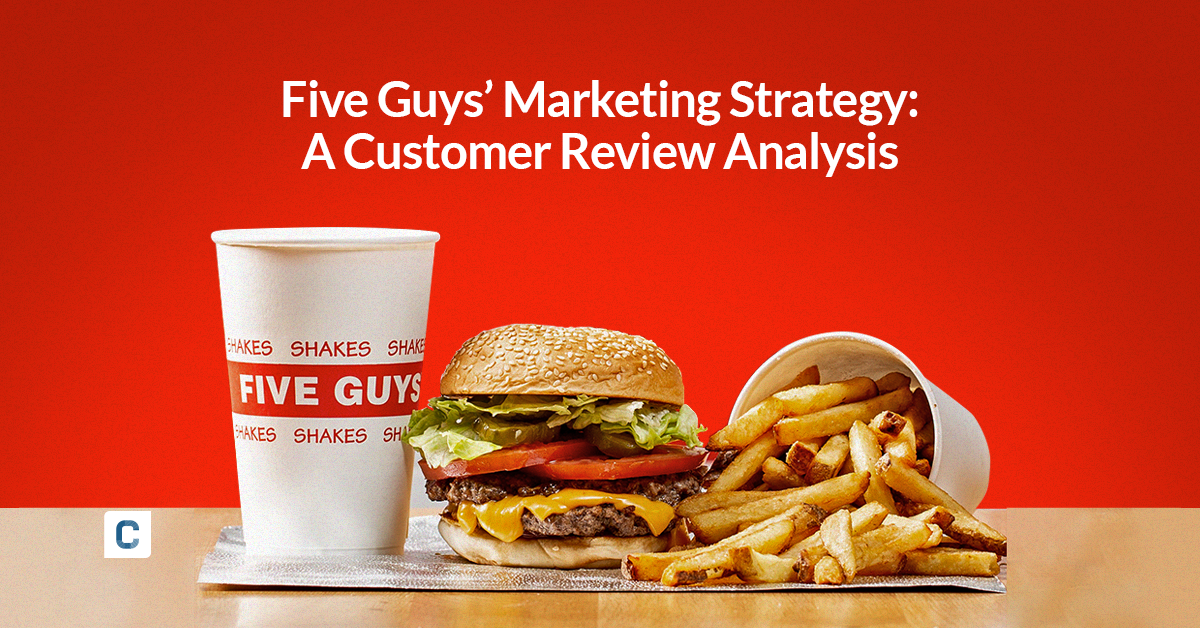
Five Guys caters to burger lovers seeking high-quality food and friendly service – all while keeping things simple. To understand how Five Guys operates its successful marketing strategy, we analyzed 1,236 Google Maps reviews using the text analysis tool, Caplena.
Everything You Need to Know About The Job Market After Covid 🦠
In the last two years, our work practices have undergone some significant changes. At the present time, there appears to be an increase in the number of job switches. This article examines the reasons for this by analyzing various studies – as well as our own in-house survey.
6 Things That Make Christmas Markets so Irresistibly Christmassy
What are the most common things people mention when they talk about their most recent Christmas market visit? To find out, we studied three highly rated – but different – Christmas markets to analyze their Google reviews.
How to Collect Surveys and Conduct Feedback Analysis in 1 Day
The research world is like a toolbox. Within the toolbox are surveys, focus groups, and experiments. Recently, the size of this toolbox has increased with social media, internet-based surveys, and mobile phones being used more frequently...
Analyzing Netflix Open-Ended Feedback: A 3½-Step Video Tutorial
This tutorial is all about Netflix! : We’ll take you through every step required to evaluate your open texts with the help of AI. If you follow the 3 required steps described in the guide below in all detail, it will take you approximately 45 minutes to get to achieve these results.
Customer Review Champion: Adidas vs Nike
Who is the GOAT, Messi or Ronaldo? Are you a Derrick Rose or LeBron James fan? Do you prefer Collin Morikawa or Rory McIlroy? Depending on your answers, it is likely we could predict your favorite footwear brand. How?
Five Guys’ Marketing Strategy: A Customer Review Analysis
Five Guys caters to burger lovers seeking high-quality food and friendly service – all while keeping things simple. To understand how Five Guys operates its successful marketing strategy, we analyzed 1,236 Google Maps reviews using the text analysis tool, Caplena.
Everything You Need to Know About The Job Market After Covid 🦠
In the last two years, our work practices have undergone some significant changes. At the present time, there appears to be an increase in the number of job switches. This article examines the reasons for this by analyzing various studies – as well as our own in-house survey.
6 Things That Make Christmas Markets so Irresistibly Christmassy
What are the most common things people mention when they talk about their most recent Christmas market visit? To find out, we studied three highly rated – but different – Christmas markets to analyze their Google reviews.
How to Collect Surveys and Conduct Feedback Analysis in 1 Day
The research world is like a toolbox. Within the toolbox are surveys, focus groups, and experiments. Recently, the size of this toolbox has increased with social media, internet-based surveys, and mobile phones being used more frequently...