Surveys Are Dead. Long Live Conversations.

Maurice Gonzenbach
Co-Founder and Co-CEO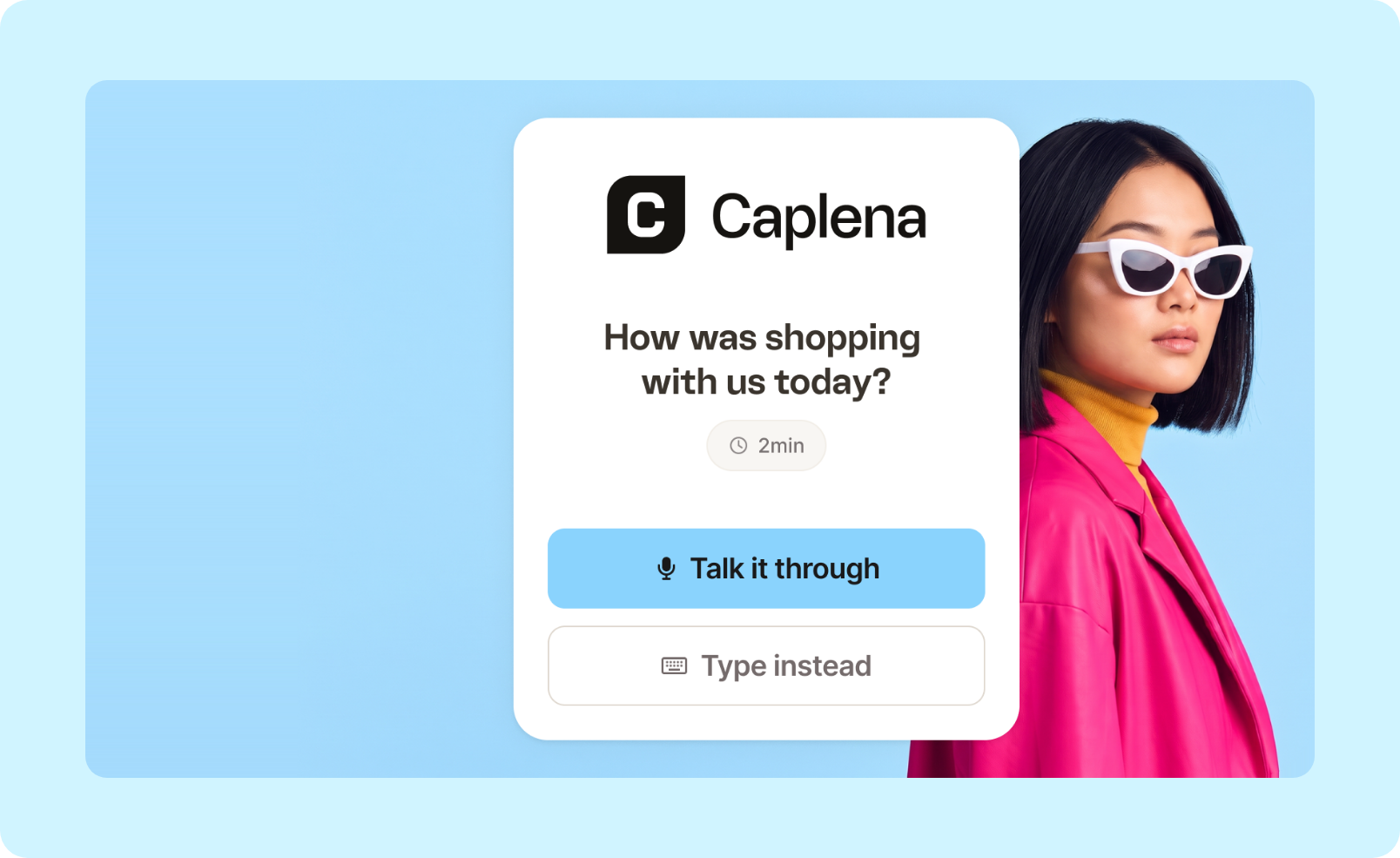
For years, customers asked us the same question: “Can we run our surveys in Caplena?” And for years, we said no. We analyze feedback. Collecting it was someone else’s job.
Then we looked at both ends of a typical survey. Respondents dislike long surveys. Researchers dislike analyzing open ends. One side scrolls through a grid of twenty statements on a screen. The other spends a week coding whatever answers survived.
So we decided to fix both. Meet Caplena Surveys: conversational surveys your customers answer by typing or talking, drafted from a brief in minutes, and analyzed right where they’re collected.
Surveys aren’t really dead, of course. We believe the paper form dressed up as a web page is. Long live conversations.
Let’s start with facts
Survey-takers rank a clean phone layout (39% UK, 34% US) and simple questions without grids (36%, 42%) above a conversational tone (23%, 22%), according to Cint’s 2026 respondent survey.
In a 2,006-person study by Rival Technologies and Reach3 Insights, open answers were 5x longer with AI probes than in traditional surveys.
In our analysis of 100,000+ Caplena projects, answer rates to open questions held up to about five or six per survey. Beyond that, empty answers climbed sharply.
In Caplena Surveys, respondents answer by voice or text in 20 languages, probing is a per-question switch, and every answer flows into Caplena’s analysis. Early access opens before Christmas 2026.
Nobody loves a long survey.
Let’s take the lens of the people answering. In Cint’s report The state of respondent satisfaction (October 2026), 69% of US and 68% of UK survey-takers said they take surveys mainly on a smartphone. Asked for the most refreshing feature of a well-designed survey, they didn’t ask for confetti or a chatbot. They asked for less clutter:
| Most refreshing feature (one answer) | UK | US |
|---|---|---|
| A clean layout optimized for my phone screen | 39% | 34% |
| Simple multiple-choice questions with no text grids | 36% | 42% |
| A conversational, human-sounding tone | 23% | 22% |
| Other | 2% | 2% |
Source: Cint, 950 active survey-takers on Cint Exchange (panel members, not a brand’s customers).
Now let’s look through the lens of the people asking. A thousand open-ended answers can still mean an export, a spreadsheet and days of coding before anyone sees a result. No wonder some teams cut open questions.
What changed? Phones made surveys personal, and large language models can now follow up like a good interviewer and make sense of thousands of answers in dozens of languages.
"Most people answer surveys on their phone, and more and more of them talk to it rather than type. The classic satisfaction survey ignores both. As LLM’s have become so much more reliable and fast, it’s time to upgrade the traditional satisfaction surveys to increase detail in feedback and improve response rates."
Most people answer surveys on their phone, and more and more of them talk to it rather than type. The classic satisfaction survey ignores both. As LLM’s have become so much more reliable and fast, it’s time to upgrade the traditional satisfaction surveys to increase detail in feedback and improve response rates."
Pascal de Buren
Co-Founder & CEO

So surveys aren’t dead. The form is. Here’s what we built to replace it.
So, what’s Caplena Surveys?
A conversational survey asks one question at a time, in a human tone, and lets people answer by typing or talking. Caplena Surveys is the survey tool built into Caplena’s feedback intelligence OS. It runs conversational surveys on a clean screen that works on any phone or desktop. It’s not a chatbot making small talk. We designed a WhatsApp-inspired survey interface that feels like someone is listening.
What you get at launch:
A skilled agent that drafts from your brief. Tell it what you want to learn, and it writes the survey. Edit by hand or keep chatting until it’s right.
Voice or text answers. Respondents choose at the start and can switch on any question. Surveys run, and answers are transcribed, in 20 languages; your team reads them in the original or in translation.
Every standard question type: NPS, CSAT, CES, ratings and scales, single and multiple choice, open text and more. Matrix questions too; they just don’t have to be the default.
Optional AI probing, set per question (more on that below).
Analysis built in, from the first answer.
[VIDEO TO ADD: 15-second Caplena Surveys walkthrough]
Enough features. Here’s what it looks like on a Monday morning.
Live by lunch: 3 surveys to start with
Each example starts with a brief for the agent. It drafts, you review, and the survey is live before lunch.
From checkout to voice note
The brief: “Create a three-question survey for customers who just ordered from our online shop. Ask for a CSAT score, then let them tell us, by voice or text, why they gave that score and what almost stopped them from buying.”
Where this helps: Customers who just checked out are on their phone and short on time. Talking beats typing with your thumbs, so you hear the detail they’d otherwise skip, and checkout friction shows up as a topic, not a hunch.
From NPS score to the why behind it
The brief: “Build our quarterly relationship NPS survey. Ask the NPS question, then an open question on the main reason for the score, with an AI follow-up.”
Where this helps: A follow-up turns “it’s fine” into something you can act on, and a prompt decides when it triggers (for instance, when an answer is short or mentions a topic you care about like staff mentions). Because the tracker runs in Caplena, you can improve the questionnaire between waves and keep your trend lines. More in our guide to large-scale tracking studies.
From one market to 20 languages
The brief: “Create a customer satisfaction survey for our customers across Europe, with an open question they can answer by voice.”
Where this helps: Customers answer in their own language. Your team in London reads the answers from Madrid and Warsaw in translation, and one Topic Collection covers every market, so you compare countries on the same topics.
One switch in those briefs deserves a closer look.
AI probing, on your terms
AI probing means a follow-up question based on what the respondent just said. In a study of 2,006 respondents in the US and Canada, Rival Technologies and Reach3 Insights found open answers were 2.5x longer in chat-based surveys than in traditional online surveys, and 5x longer with AI probes.
Yes, that’s a vendor study: Rival sells chat-based surveys. Now so do we, which is exactly why we’re telling you.
One more finding for trackers: switching to a chat format didn’t significantly shift closed-ended scores.
Probing also changes how many questions you need. When we analyzed 100,000+ projects in Caplena to see how many open-ends is too many, answer rates held up until about five or six open questions per survey. Beyond that, blank answers climbed sharply. A follow-up gets you richer answers from fewer questions.
Longer answers aren’t free, though: every follow-up adds time, and a respondent who hears “Can you tell me more?” after every answer soon stops telling you more.
That’s why we made probing a per-question switch you can guide with a prompt: on for the “why” behind a score, off where a number says it all. Our AI playbook for open-ended feedback covers when open questions are worth asking.
Of course, five times more text is only good news if someone reads it.
No export, no coding sprint
This is the part we’ve solved since 2018. Every answer, typed or spoken, flows into a Caplena project, where our AI builds a Topic Collection you can fine-tune and assigns topics with topic-level sentiment: what people talk about, and how they feel about it.
From there, Insights Radar surfaces emerging issues, Alerts flag topics that cross a threshold, the Insight Agent answers questions in plain language, and Smart Columns turn free text into structured fields. Survey answers sit next to the rest of your feedback: reviews, support tickets, or survey data you import from Qualtrics or Medallia.
Comparing AI survey tools? Our Caplena Surveys page answers the common questions.
Who we built Caplena Surveys for
CX and insights teams first: the people running VoC programs, trackers and ad-hoc studies. Our beta customers came with CX use cases.
But any brand or agency team that wants a survey live by lunch will feel at home.
With Caplena Surveys, Caplena covers your whole VoC program in one platform: collect, analyze, report, share and act. Heavyweight insights, featherweight lift.
You can also run Caplena Surveys next to the platform you already use: if you collect in Qualtrics or Medallia today and analyze in Caplena, that keeps working.
How is this different from a survey tool?
It starts from the other end. Survey platforms grew up around collection and added analysis later; we built the analysis first, with CX and insights teams, and then added collection.
So Caplena Surveys is designed for the decisions that come after the survey closes: which topics drag your NPS down, which issue is new this month, and which team needs to act on it.
Open questions aren’t a cost to keep low. They’re where those answers come from.
Start a conversation with your customers
Early access opens before Christmas 2026. Join now to get in first and shape what comes next: survey creation from Slack, Microsoft Teams and MCP, CRM distribution and automated follow-up research.
Want to see it before then? I’ll walk through Caplena Surveys live in our webinar on 10 December.
Rather judge it as a respondent? Take our 5-minute Insights Vibe Survey 2027, which runs on Caplena Surveys, and get the results first in our Future of AI in Insights report (January 2027).
Respondents dislike long surveys. Researchers dislike analyzing open ends. We solve both. Your turn to start the conversation.