What Are Agentic Insights? 5 Myths Debunked.

Prerana Sastri
Content Marketing Manager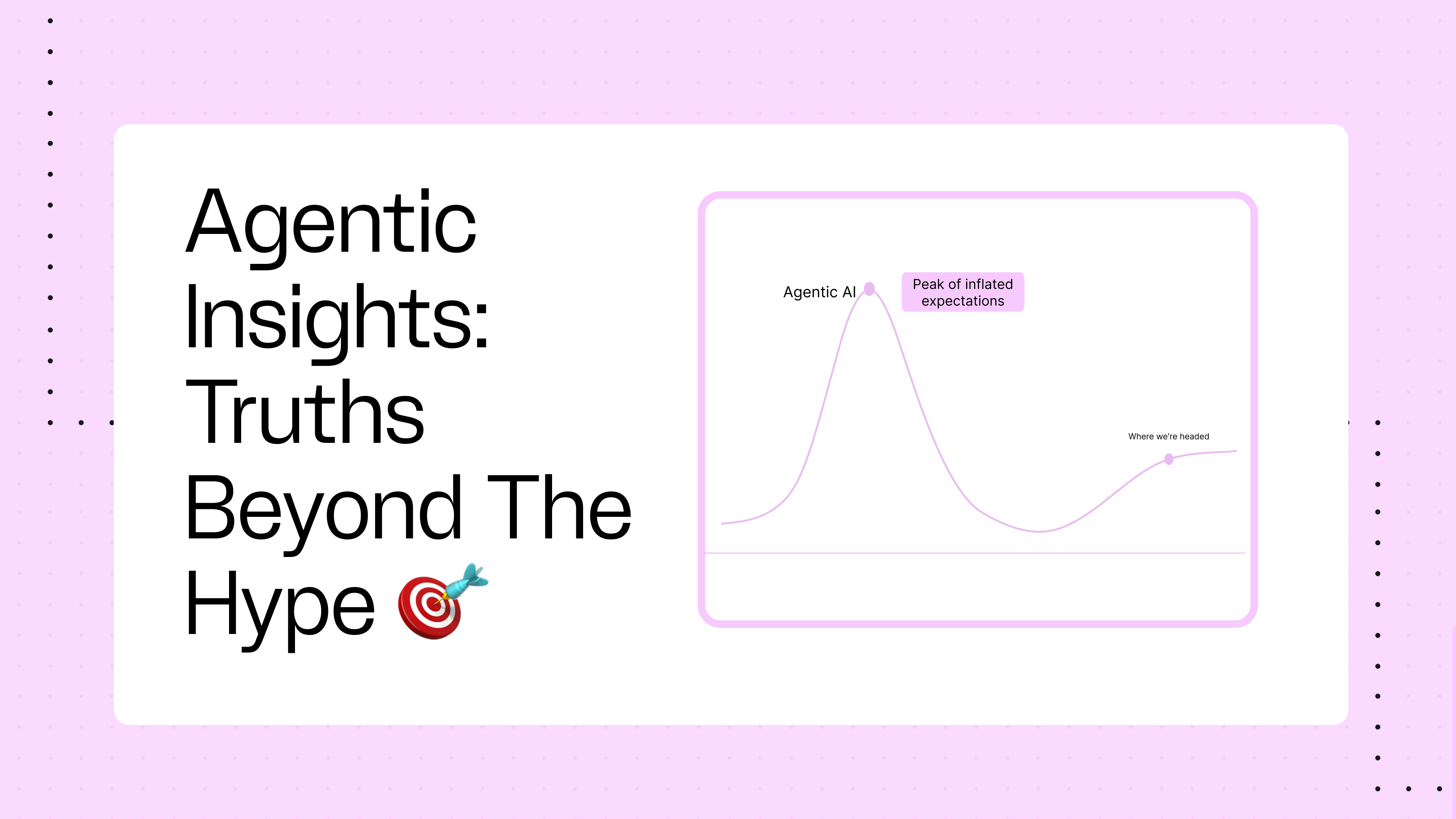
Everyone’s talking about AI agents in customer intelligence and market research.
Vendors say it will transform everything from customer service to analytics. Leaders are asking their teams to “become agentic.” Pilots are being launched everywhere.
At the same time, the latest Gartner Hype Cycle places agentic AI right at the Peak of Inflated Expectations. This means there’s a lot of excitement, but not always much clarity.
Despite all the noise, there’s genuine confusion about what agentic insights means, especially for insights and CX professionals trying to figure out what’s worth their attention right now.
So we’re taking a closer look at the topic, challenging five common misconceptions about Agentic Insights, along with a more realistic view of how teams can start exploring it right away:
Agentic Insights: How we define it 👇
Agentic insights are insights produced by AI that work through a question like a research assistant would. This means exploring data, running analyses, and refining its findings until it reaches a structured answer.
"I like to explain it through how the interaction feels. Non-agentic AI is like a search query. You type something in and instantly get back what’s already there. Agentic insights feel more like working with an insights professional. You give them a question, they plan how to approach it, look at the data from different angles, review their findings, and then come back with a structured output.
I like to explain it through how the interaction feels. Non-agentic AI is like a search query. You type something in and instantly get back what’s already there. Agentic insights feel more like working with an insights professional. You give them a question, they plan how to approach it, look at the data from different angles, review their findings, and then come back with a structured output.
Pascal de Buren
CEO & Co-founder

In Caplena’s context, this happens through Insight Agent, which acts as an AI research assistant that analyzes customer feedback and survey data to uncover patterns, drivers, and key themes, within minutes.
Agentic AI vs Generative AI: Understanding the Difference
Agentic AI leverages generative AI to focus on orchestrating and executing tasks through autonomous AI agents using large language models (LLMs). While generative AI primarily creates new content such as text, images, or code based on input prompts, agentic AI extends these capabilities by applying generative outputs to perform complex workflows and achieve higher-level goals.
"The core difference is that an agent can handle multi-step problems. It doesn’t just respond with the first thing that “comes to its head”. It can take several turns, dig through different resources, and decide which tool or analysis to use next based on what it finds. It can also review its own previous steps and adjust course.
The core difference is that an agent can handle multi-step problems. It doesn’t just respond with the first thing that “comes to its head”. It can take several turns, dig through different resources, and decide which tool or analysis to use next based on what it finds. It can also review its own previous steps and adjust course.
Maurice Gonzenbach
CEO & Co-founder
5 common myths about Agentic Insights
#1 Agentic AI is just a fancier chatbot. 💅
Traditional AI tools like chatbots or basic search interfaces work like a Google query. You type something in and you get something back. One prompt, one answer, which means the output is fast, but surface-level.
An agentic system is fundamentally different and built for complex tasks. Instead of returning a single result, it plans a path, executes multiple steps, uses different tools along the way, and reviews its own reasoning before surfacing insights.
So you're not limited to questions like "how many customers mentioned delivery issues?" With our Insight Agent, you can ask more complex questions like "what are the key drivers of dissatisfaction in our top 5 markets, and how have they shifted over the last quarter?"
💡Bottom line: A chatbot retrieves. An agent reasons, plans, executes, and self-corrects across multiple steps before coming back to you with a real answer.
#2 AI agents hallucinate and can't be trusted! 😵💫
This is a real concern with many generic AI tools, and it's worth taking seriously.
When an LLM or NLP model is fed raw, unstructured data and asked to produce statistics, it can (and does) invent numbers. That's a problem for anyone making business decisions.
But purpose-built insights agents approach this very differently. Rather than asking the AI to compute statistics itself, well-designed systems give the agent guardrails, while keeping human-in-the-loop.
The quantification happens through a reliable, coded system that's based in your data and the AI decides which calculation to run and interprets the result, but it never makes up the numbers itself.
This also means the agent can work confidently at scale. Querying patterns across a million rows of coded feedback data is not the same as asking a generic LLM to summarise a spreadsheet.
💡Bottom line: Hallucination risk is real, and no system eliminates it entirely yet. However, when AI agents are built on structured, pre-coded data with reliable quantification underneath, the risk drops by orders of magnitude compared to directly asking a generic LLM.
#3 Agentic insights is only valuable for data scientists. 👩💻
One of the most exciting things about mature agentic insights tools is precisely the opposite: they democratise access to customer intelligence across the entire organisation.
Previously, getting a meaningful answer to a customer question required submitting a request, waiting for an analyst, and receiving a PowerPoint a few days later.
Most ad hoc questions never got answered at all and not because they weren't valuable, but because the effort simply didn't justify the cost.
Now, a product manager can ask "how do customers in Germany feel about our new onboarding flow?" in a Slack channel and get a real, substantiated answer within minutes.
A board meeting question that would have taken three days of analyst time can be answered on the spot. The insights function stops being a bottleneck and starts being infrastructure.
💡Bottom line: When insights take minutes instead of days, every team in the company can make customer-informed decisions — not just those with dedicated research support.
#4 AI agents will take autonomous actions. 🤖
The word "agentic" does imply a degree of autonomy and yes, the long-term vision for these systems does include triggering actions, not just surfacing insights.
Right now, the most mature and genuinely useful agentic capabilities are in the research and analysis layer: autonomously planning an investigation, pulling the right data, running driver analyses, slicing by market or segment, and returning a coherent strategic answer. That's the use case that's ready today.
The goal post is shifting quickly, but "autonomous action" is not a prerequisite for an insights agent to be genuinely valuable right now. The best systems today keep a human in the loop by design. The agent surfaces a finding or recommends a next step, and you decide whether to act on it.
💡Bottom line: Don't wait for AI agents that promise to close the loop without human oversight. The research assistant use case is mature, proven, and valuable today.
#5 AI agents will fix bad data. 👩🔧
This might be the most important myth to debunk, because it's the one most likely to lead to failed pilots and soured expectations.
An agentic insights workflow is only as good as the data it's working with. If your feedback data is unstructured, inconsistent, or uncoded, you're setting up your agent to make sense of chaos.
Garbage in, garbage out applies here just as much as anywhere else in analytics.
The reason purpose-built insights agents can answer high-level strategic questions is precisely because they work on data that has already been structured and coded. That foundation is what allows the agent to slice by market, run driver analyses, and quantify reliably; rather than just pattern-matching on raw text.
Before investing in any agentic layer, ask yourself: is my data foundation solid enough? Have I solved the upstream problem? If the answer is no, that's where to start.
💡 The rule: A great AI agent on messy data gives you confident-sounding nonsense. Solve your data quality problem first, then let enable the AI agent close the feedback loops.
Implementing Agentic Insights: Best Practices and Considerations 📍
Implementing agentic AI requires a strong data foundation, including high-quality data sources, structured data inputs, and integration with existing enterprise systems and BI tools. Governance frameworks and human oversight are essential to ensure responsible agent behavior, compliance with data privacy regulations, and alignment with business objectives.
Key Benefits of Using Agentic Insights
Speeds up data analysis by autonomously exploring datasets, running multi-step analyses, and delivering real-time answers, reducing time-to-insight from days to minutes.
Improves decision quality by analyzing more variables and historical data as compared to manual processes, uncovering root causes and predicting trends.
Democratizes data access, allowing non-technical users to ask complex questions using natural language and get reliable answers quickly.
Automates repetitive tasks like monitoring metrics and generating reports, reducing analytics backlog and freeing teams for strategic work.
Integrates with existing systems through structured data and governance, ensuring compliance and responsible AI use.
💡Bottom line: Agentic insights enable faster, accurate, and accessible data-driven decisions with human oversight and governance
Building the Data Foundation for Agentic Insights
Agentic insights depend on a strong data foundation.
For an insights agent to investigate questions, run analyses, and synthesize findings, the underlying data needs to be structured and organized in a way the system can work with. This starts with clear data organization and governance.
With Caplena, the data foundation for agentic insights typically includes:
Your data sources such as survey data and Voice-of-Customer feedback
Your projects and project context, including columns and column descriptions
Smart Columns that structure attributes extracted from open-text feedback
Topic collections and sentiment analysis that organize qualitative feedback into themes
The statistical backbone of Caplena, including p-values, correlations, driver analysis, and net sentiment scores used across the reporting suite
Segments and filters that allow analysis across markets, products, or customer groups
Alerting thresholds and monitoring frequency for tracking changes in key metrics
User permissions and governance to manage access and ensure responsible use of insights
These elements create the foundation that allows agentic insights to investigate questions across datasets and produce reliable answers.
Getting Started with Agentic Insights Workflows ⚡️
"Caplena's Insight Agent provides you with valid data to a depth people are surprised by – visuals in Insight Agent are a real game changer for us.”
Caplena's Insight Agent provides you with valid data to a depth people are surprised by – visuals in Insight Agent are a real game changer for us.”
Niklas Melchior
Customer Insights Expert

Once your data foundation is in place, agentic insights become much more than a technical capability. They become a new way of working with customer intelligence.
Instead of running analyses manually, building reports, and responding to questions after the fact, insights teams can start delegating analytical work to an AI research assistant.
In practice, the first steps often look like this:
Use agentic insights to answer your own business questions faster.
Instead of running multiple analyses manually, ask a strategic question and let the agent investigate the data and return a structured answer.Answer stakeholder questions without building a report first.
When an executive asks a question, the agent can explore the data and provide a quantified answer in minutes.Make decisions during meetings, not after them.
Questions that previously required days of analysis can now be investigated in real time.Automate recurring insight workflows.
Agents can monitor key metrics and generate scheduled insight digests so teams stay on top of emerging patterns.Close the loop on improvements.
After launching a product or CX change, you can ask the agent to revisit the data weeks later and report whether the improvement moved the needle.Enable self-service insights across the organisation.
Stakeholders can explore customer feedback directly while insights teams maintain governance and methodological rigor.
In Caplena, these workflows are enabled through Insight Agent, which acts as a research assistant across your customer feedback and survey data by planning analyses, running statistical tests, and synthesizing findings into structured answers. See it in action 👇
The Future of Agentic Insights and Analytics
Agentic insights or analytics agents are promising but they're not magic. The technology is fairly new and no tool in this space has been battle-tested for more than about a year. That's worth remembering when evaluating what vendors are promising.
What is true is that for insights and CX professionals, the core use case: an AI agent that can autonomously investigate a complex question, synthesise across your data, and return a high-quality, quantified answer that moves the needle.
The organisations that will win are the ones who cut through the hype, get their data foundations right, and start using this capability for the questions that matter and help them make decisions faster.
Have questions about what agentic insights could look like in practice? We'd love to chat!
- Agentic Insights: How we define it 👇
- Agentic AI vs Generative AI: Understanding the Difference
- 5 common myths about Agentic Insights
- Key Benefits of Using Agentic Insights
- Building the Data Foundation for Agentic Insights
- Getting Started with Agentic Insights Workflows ⚡️
- The Future of Agentic Insights and Analytics